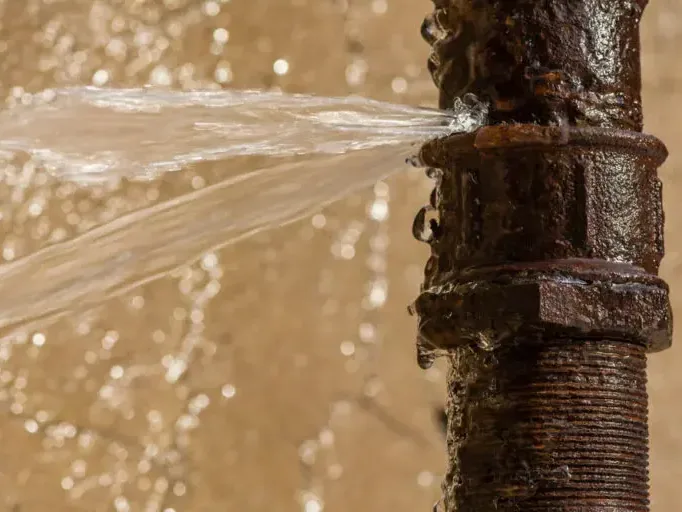
Water in the street, a sinkhole at the curb or a sudden loss of pressure points to a public main break, while a stain spreading across a wall points inside the building. In Escondido the first is a City repair and the second is a private plumbing problem, and the cleanup inside the building is the same job either way.
Key takeaways
- A public main break is a City repair, and a burst pipe inside a building is a private plumbing problem.
- On January 14, 2025, two mains broke in one afternoon and evening: one near Olivia Glen and Vermont Avenue that opened a sinkhole, and one on Oak Hill Drive.
- Water in the street, a sinkhole and no water for neighbors suggest a public break. A spreading stain or a spinning meter suggests the building's own pipes.
- A water outage or overflow is reported to the City's Public Works department, and emergencies go to 911.
- Water that reaches a building from outside is treated as contaminated, while a clean supply pipe leak is dried the same way once the source is stopped.
Two kinds of leak that look alike
A burst pipe inside a building and a break in a public main both end with water where it does not belong. The difference is who owns the pipe, and that decides who fixes it.
The City's Utilities Department handles water treatment and distribution, wastewater collection and treatment, recycled water and stormwater management. City of Escondido Water Utilities serves most water customers within the city, and Rincon del Diablo Municipal Water District serves some portions of it.
Pipes inside the building belong to the owner. A plumber repairs them, and a restoration crew handles the water they released.
What the January 2025 breaks showed
On January 14, 2025, a large water main burst near Olivia Glen and Vermont Avenue just after 2 p.m. It opened a sinkhole and cut water to around 100 residents, and a vacant townhome and a parked vehicle were damaged.
Less than six hours later, a second main broke on Oak Hill Drive west of South Midway Drive. It left 20 homes and Oak Elementary School without water until about 2 a.m. the next morning.
Two lessons follow. A main break can damage property near the street, and it can shut off water for a whole block at once, which is very different from one household's burst pipe.
How to tell which kind of leak it is
Signs pointing to a public main
- Water flowing in the street, gutter or a neighbor's yard with no obvious source.
- A sinkhole or sunken pavement near the curb.
- Low pressure or no water at several homes on the same block.
- A hissing or rushing sound outdoors near a valve cover.
Signs pointing to the building's own pipes
- A stain or bubbling paint that grows on a wall or ceiling.
- The water meter keeps moving with every tap and appliance off.
- Damp carpet, swollen baseboards or a musty smell in one part of the house.
- Normal pressure at the neighbors, but trouble at one property.
Who to call
A water outage or a sewer overflow is reported to City of Escondido Public Works, and emergencies go to 911. The public side of the system is not something a restoration crew repairs.
Inside the building, the calls are different, and they can happen at the same time.
- Plumber: repairs the burst pipe, fitting or valve on the private side.
- Restoration crew: extracts water, opens wet walls and dries the structure.
- Landlord or property manager: for rentals, tell the owner in writing right away.
- Neighbors: if several homes have no water, a main break is likely, and it should still be reported.
What street water does when it reaches a property
Water from a broken main does not stop politely at the property line. It follows grade, so low spots, driveways and garage doors take it first.
Once it finds a way in, it moves quickly across hard floors and soaks into anything porous.
- Garage: water slides under the door and spreads across the slab toward stored boxes.
- Doorways: it runs over thresholds and wicks into the base of the wall.
- Landscaping: saturated soil next to a foundation pushes moisture toward the slab edge.
- Neighboring units: in a multifamily building, water can travel to the units below or beside.
When water reaches a building from outside
Water that comes through a door or foundation after a main break has crossed pavement, soil and gutters. It is handled as contaminated until proven otherwise, so porous materials that soaked it up are usually removed.
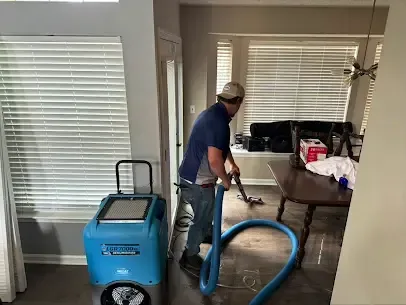
Water extraction comes first, followed by drying of the walls and floors. Moisture readings show how far the water traveled beyond what is visible.
When the pipe that burst is inside
A burst pipe is usually clean supply water at first, so the priority is closing the main shutoff valve for the house and moving belongings out of the way.
Burst pipe and pinhole leak cleanup opens the wet wall or ceiling cavity, removes wet insulation and dries the framing. Hidden water inside a wall keeps spreading until it is found.
- Close the main shutoff valve, then open a low tap to relieve pressure.
- Move rugs, electronics and furniture legs out of the wet area.
- Photograph the damage and the pipe before anything is removed.
- Keep the broken fitting if possible so the plumber can see how it failed.
After an outage: the tap left open
Water outages create a second risk. A faucet, hose or appliance left open during the outage can flood the room when service comes back.
Before pressure returns, close the taps that were left running and check that washer and dishwasher valves are shut. A quick walk through the house avoids a second loss.
Records that help later
A short written record makes every later conversation easier, whether it is with a landlord, a plumber or the restoration crew.
Dated photos and a few notes are enough. If the drying crew needs to open a wall, structural drying readings add a second record of how far the water traveled.
- Photos of the source, the water and the damage, taken before cleanup.
- The time the problem was noticed and when the water was shut off.
- A note of what was moved, discarded or set aside.
- Names of anyone who was called and when.
Questions
Who repairs a water main break?
A public main break is a City repair. A burst pipe inside a building is a private plumbing problem repaired by a plumber.
Where should a main break or outage be reported?
To the City's Public Works department. Emergencies go to 911.
How can a homeowner tell a main break from a burst pipe?
Water in the street, a sinkhole or no water for neighbors suggests a main. A stain on a wall or a meter that keeps moving suggests the building's own pipes.
Is water from a main break clean?
Not once it has crossed pavement and soil to reach a building. It is treated as contaminated, and porous materials are usually removed.
Can a restoration crew start before the plumber finishes?
Usually yes, once the water is shut off. Extraction and drying can begin while the plumber schedules the repair.
What should a tenant do after a burst pipe?
Tell the landlord or property manager in writing, photograph the damage and keep belongings out of the wet area while the cleanup is arranged.