Structural Drying and Dehumidification in Poway, CA
Dry to the touch is not dry. The drying team sets air movers and LGR or desiccant dehumidifiers to the class of the loss and logs readings daily until framing, drywall and concrete reach the IICRC S500 drying goal.
(888) 450-9281Get the drying set up right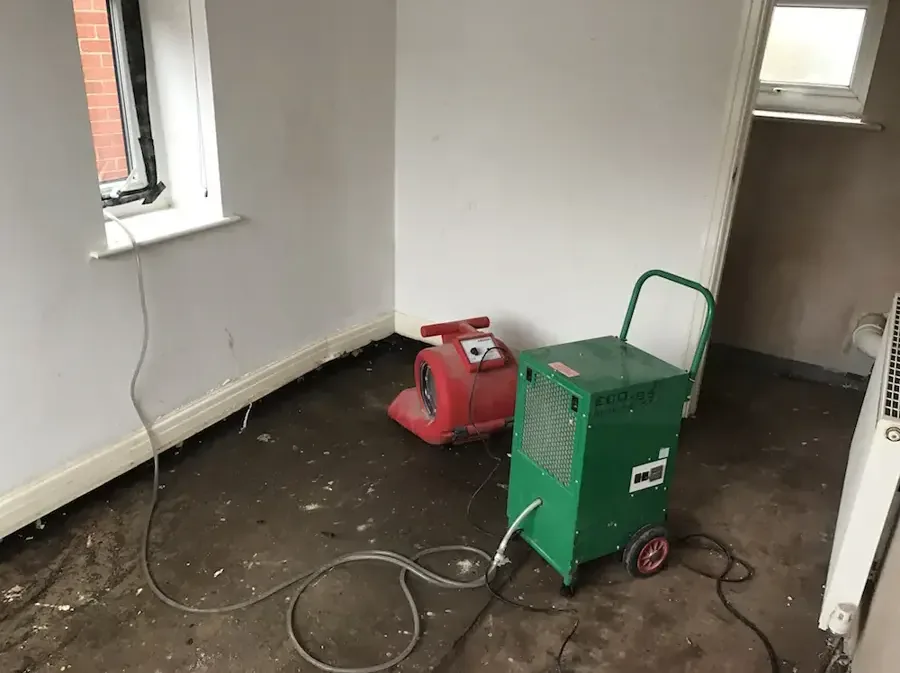
What to do right now about structural drying and dehumidification
- No. 1Keep the water off. Make sure the source is shut off and repaired before drying starts.
- No. 2Leave the equipment running. Do not switch off air movers or dehumidifiers, even overnight.
- No. 3Keep doors and windows as set. The drying team sets them to control humidity; ask before opening them.
- No. 4Call if a unit stops. Most job-site dehumidifiers pump out on their own; call if one shuts down.
How structural drying and dehumidification is handled in Poway, CA
- 1
Map and class
Moisture mapping and the IICRC S500 class set the drying plan for each room.
- 2
Set the equipment
Air movers and LGR or desiccant dehumidifiers go in, sized to the evaporation load.
- 3
Log every visit
Readings, temperature and humidity are recorded, and equipment moves as areas dry.
- 4
Verify and remove
Equipment comes out when the wet materials match the dry reference.
What does structural drying and dehumidification cost in Poway, CA?
In Poway, structural drying typically runs $1,200 to $10,000 or more, depending on the class of the loss, how many rooms and materials are wet, whether a slab or hardwood needs desiccant drying and how many days the equipment runs.
One or two rooms
- Air movers and one LGR unit
- Moisture mapping
- Three to five days of logs
Several rooms
- Wall cavity drying
- Multiple LGR units
- Daily psychrometric logs
Class 4 or whole house
- Desiccant dehumidifiers
- Slab and hardwood drying
- Extended monitoring
Ranges are typical, not a quote. The water category, the square footage, the material class and how fast drying started move the number most; the water damage cost calculator gives a closer planning range.
Structural drying is the part of a water job that decides whether the house is really dry. Water that soaked into framing, the bottom of the drywall, the slab or a cabinet base does not leave on its own fast enough; it has to be pulled out on purpose and measured.
How a drying plan is built
The tech who does the walkthrough maps moisture with pin and pinless meters and thermal imaging, then classes the loss under the IICRC S500 standard. Class 1 is a small area with little absorption; Class 4 is dense material such as concrete, hardwood and plaster that holds water tightly. The class sets how many air movers and how much dehumidifier capacity each room needs.
- Air movers aimed along wet walls and floors to speed evaporation.
- LGR dehumidifiers to pull that moisture back out of the air.
- Desiccant units for concrete, hardwood and cool, damp spaces.
- Floor-drying mats and wall cavity injection where water hides.
Why dry inland air is not enough
Even on a dry day, a closed house with wet walls fills with humid air, and wet materials stop drying. Opening windows can help or hurt depending on the weather outside, which is why the drying team measures temperature and humidity inside and out and records them in a psychrometric log on every visit.
Proving the job is done
Each wet material is compared against a dry reference of the same material in an unaffected part of the house. Equipment comes out when the wet readings fall within 2 to 4 points of that reference, and those readings, with the photos and the moisture map, go into the claim file. Concrete drying is covered under slab leak water damage, and the drying time estimator gives a typical timeline.
The EPA indoor air quality pages explain why indoor moisture matters, and the California Department of Insurance covers documenting a homeowners claim.
Structural Drying and Dehumidification questions
Why can't fans and open windows dry the house?
Household fans move air but do not remove moisture, and open windows can let humid air in. Structural drying pairs air movers with dehumidifiers and measures the result.
How many air movers does a room need?
It depends on the size of the room, the wet wall and floor area and the class of the loss under the IICRC S500 standard. The drying team calculates it rather than guessing.
What is an LGR dehumidifier?
LGR stands for low grain refrigerant. These dehumidifiers keep pulling moisture out of the air even when the air is already fairly dry, which household units cannot do well.
When is a desiccant dehumidifier used?
Desiccants work well on dense materials such as concrete and hardwood, and in cool spaces where refrigerant units slow down.
Is the drying equipment noisy?
Air movers and dehumidifiers run continuously and do make noise. Keeping them on day and night is what keeps the drying time short.
How is dry measured?
Each wet material is compared with a dry reference of the same material elsewhere in the house. When the wet readings come within 2 to 4 points, the material is dry.
Structural drying and dehumidification across Poway and nearby
The restoration crew covers ZIP 92064 and 92074, from the older homes around Midland Road to Green Valley, Garden Road, Twin Peaks, Old Coach, High Valley and the homes up in Sycamore Canyon.
Nearby coverage reaches Rancho Bernardo, Rancho Peñasquitos, Sabre Springs, Carmel Mountain Ranch, Scripps Ranch, Ramona and Escondido.
More water damage services
Walls still damp after a leak? Call before it sets in.
The drying team sizes the equipment to the loss and logs readings daily until every material reaches the IICRC S500 goal.
(888) 450-9281Get the structure dried to the readingsPoway Water Damage Restoration
San Diego County, California
Open 24 hours, holidays included
Find us on Google