When sewage rises in a shower or floor drain, the first question is whose pipe it is. In Escondido, the City maintains the public sewer main, and each building connects to that main through a sewer lateral that belongs to the owner.
Key takeaways
- Under Escondido Municipal Code Section 22-165, the owner maintains and repairs the sewer lateral from the building to the public main, including the part under the sidewalk and street.
- When a backup occurs, the City inspects the public sewer main at no charge, and a clear main means the blockage is probably in the lateral.
- A sewer overflow is reported to the City's Public Works department, and emergencies go to 911.
- Sewage is Category 3 water, so porous materials that touched it are removed and hard surfaces are cleaned and treated.
- The City's inspection decides who repairs the pipe. A restoration crew handles the contamination inside the building either way.
Two pipes, two responsibilities
A sewer system has two parts that matter to a homeowner. The public sanitary sewer main runs under the street and is maintained by the City.
The sewer lateral is the pipe from the building out to that main.
Section 22-165 of the municipal code puts the lateral on the owner. That covers the whole stretch from the building to the main, including the part under the sidewalk and the street.
What a sewer backup looks like
A single slow sink is usually a local clog. A sewer problem shows up in several places at once, because every fixture drains into the same lateral.
- Several slow drains: toilets, tubs and sinks all clear slowly together.
- Floor drain or tub: dark water rises at the lowest drain in the house.
- Gurgling: air bubbles up a drain when a toilet is flushed or a washer drains.
- Odor: a sewage smell near a drain, a cleanout or a yard.
What the City does when a backup is reported
When a backup occurs, the City inspects the public sewer main at no charge. That check answers the question of whose pipe is blocked.
If the main is clear, the blockage is probably in the lateral, and the owner is responsible for the repair. If the main is the problem, it is a City matter.
Reporting an overflow
A sewer overflow or water outage is reported to City of Escondido Public Works. Emergencies go to 911.
What an owner can do while waiting
Stop using water in the house, since every gallon feeds the backup. Keep children and pets away from the wet area and note when the backup began.
When the lateral is the problem
A plumber clears or repairs the lateral, often using a camera to see where it is blocked or broken. Because the owner's responsibility runs under the sidewalk and street, a repair can involve more than the yard.
The plumber's work and the building cleanup are separate jobs. The cleanup does not need to wait for the pipe to be fixed once the source is under control.
A one-time blockage is cleared and monitored. A recurring one usually points to damage, roots or a low spot in the pipe that a camera inspection will show.
- Clearing: a cable or water jet removes a blockage such as grease or a wad of wipes.
- Camera inspection: shows a broken section, a sag or an obstruction inside the pipe.
- Repair: a damaged section is replaced, which can mean digging.
- Records: keep the plumber's report and photos with the cleanup paperwork.
Writing down what happened
A clear record helps the City, the plumber and the cleanup crew all work from the same facts. It also helps when the question of who pays comes up later.
Notes written on the day are more accurate than memory a week later.
- When the backup began and which drains were affected.
- Photos of the drain, the water and anything damaged.
- Whether a neighbor has the same problem, which can point to the main.
- Who was called and what they said.
Renters and landlords
In the 2020 Census, 48.3 percent of occupied homes here were rented, so many backups involve a tenant and a landlord. The lateral is the owner's responsibility, which means the owner arranges that repair.
A tenant who notices a backup should tell the landlord or property manager in writing, with photos and the date.
- Stop using water and keep belongings off the wet floor.
- Photograph the backup before anything moves.
- Send the landlord a written note describing what happened.
- Ask who is arranging the plumber and the cleanup.
Health and safety while waiting
Sewage can carry bacteria and viruses, so even a small backup deserves care. Contact is the main risk, along with the splashes and aerosols that come from walking through wet areas.
A few habits keep the household safe until the crew arrives.
- Keep children, pets and anyone with a weak immune system away from the wet area.
- Wear rubber gloves and boots if something must be moved, and wash hands afterward.
- Do not prepare food in a kitchen that shares a drain with the backup.
- Do not run a fan or use a household vacuum on the affected floor.
How the cleanup inside the building works
Sewage is Category 3 water, the most contaminated class in the IICRC S500 standard. The crew assumes every wet porous material is contaminated.
Sewage backup cleanup follows a set order, and each step has a reason.
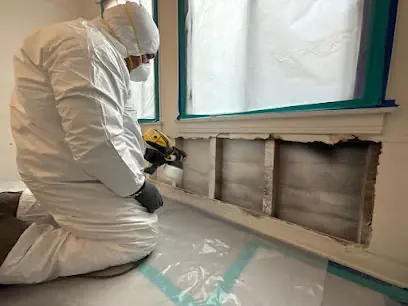
- Containment: plastic sheeting and a closed door keep the work to one area.
- Removal: wet carpet, pad, baseboards and the lower part of drywall come out.
- Cleaning: hard surfaces are scrubbed, then treated with an antimicrobial.
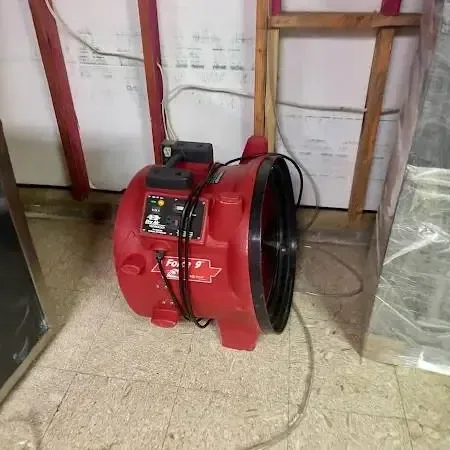
- Air scrubbing: HEPA units run during the work.
- Drying: air movers and dehumidifiers run until readings match a dry reference.
Drying and rebuilding
Once the contaminated materials are gone, structural drying takes over. Readings are logged each visit, so there is a record that walls and floors are dry.
Flooring, drywall and trim are replaced after that. Closing up wet framing too early traps moisture and can bring the smell back.
Keeping the lateral clear
The City asks residents not to flush wet wipes, even products labeled flushable, and not to put grease down drains. Both are common causes of blockages in laterals.
Those habits cost nothing and protect the pipe the owner is responsible for. Water damage restoration handles what the lateral cannot hold back when a blockage still forms.
Questions
Who is responsible for the sewer lateral?
Under Section 22-165 of the municipal code, the owner maintains and repairs the lateral from the building to the public main, including under the sidewalk and street.
Does the City check the main when sewage backs up?
Yes. When a backup occurs, the City inspects the public sewer main at no charge. A clear main points to a blockage in the lateral.
Where is a sewer overflow reported?
To the City's Public Works department. Emergencies go to 911.
Can carpet be saved after sewage reaches it?
Usually not. Sewage is Category 3, and porous materials are normally removed instead of cleaned.
What should not be flushed or poured down a drain?
Wet wipes, even those labeled flushable, and grease. The City asks residents to keep both out of the system.
Does the cleanup wait until the lateral is fixed?
Not once the source is under control. Containment and removal can start while the plumber arranges the repair.